Answering Service Per Call Pricing vs Monthly AI Plans
Compare answering service per call pricing with monthly AI receptionist plans, cost scenarios, and a worksheet to choose smarter coverage.
TL;DR
Answering service per call pricing can work when your call volume is low, short, and mostly message-taking. It becomes less predictable when callers need transfers, rescheduling, appointment booking, or after-hours help. For salons, spas, pet groomers, and fitness studios, a monthly AI receptionist plan is often easier to budget because the main value is not just “someone picked up”—it is whether the caller gets booked.
| If your business mostly needs... | Pricing model to consider |
|---|---|
| Occasional message capture | Per-call answering service |
| Long intake calls or complex questions | Per-minute answering service |
| Predictable call coverage plus appointment workflows | Monthly AI receptionist |
| A full-time front desk with in-person tasks | Employee receptionist |
DeskBuddy is built for appointment-based service businesses that want 7×24 call answering, common inquiry handling, and booking support without hiring a full-time receptionist. You can review DeskBuddy’s AI receptionist plans or explore how DeskBuddy answers appointment calls.
How per-call answering service pricing works
Answering service per call pricing charges you each time a receptionist handles a call. The rate may apply to every answered call, every billable interaction, or every call that meets a provider’s minimum handling rules.
A per-call plan usually includes:
- A base monthly fee
- A fixed number of included calls, or no included calls
- A charge for each additional call
- Optional fees for transfers, appointment booking, bilingual support, CRM updates, or after-hours coverage
Some providers also offer per-minute plans. ReceptionHQ publicly describes pay-per-call and pay-per-minute choices on its virtual receptionist pricing page. Because answering service pricing changes often, always check the provider’s current pricing page before signing.
Ask these questions before comparing quotes:
- Is a wrong-number call billable?
- Are spam calls filtered before billing?
- Is appointment scheduling included?
- Are after-hours calls charged differently?
- Are call transfers included?
- Is there a monthly minimum?
- Do unused calls roll over?
For a service business, the biggest issue is what happens inside the call. A 40-second “What time do you close?” call and a 6-minute “Can I book a balayage and toner next Saturday?” call create very different business value.
Where per-call pricing can become expensive

Per-call pricing becomes expensive when call volume rises but the outcome stays shallow. If you pay for calls that only produce messages, your staff still has to call customers back, check the calendar, answer follow-up questions, and recover missed bookings.
Common cost traps include:
- Short repeat calls: A client calls, leaves a message, calls again later, then texts.
- After-hours bursts: A promotion or Saturday rush can create more calls than expected.
- Appointment changes: Reschedules and cancellations require calendar action.
- Call transfers: If every detailed question gets transferred to the owner, interruptions continue.
- Add-on tasks: Calendar management, CRM updates, and intake capture may sit in higher tiers.
The U.S. Bureau of Labor Statistics publishes wage data for receptionists and information clerks through its Occupational Outlook Handbook. That data helps explain why live answering services exist: hiring front desk labor is a real cost.
Pricing comparison: per-call, per-minute, and monthly AI receptionist plans
Here is a practical answering service pricing comparison for appointment-based local businesses. Vendor details vary, so treat non-DeskBuddy rows as pricing models rather than universal rates.
| Pricing model | How billing works | Best fit | Watch-outs |
|---|---|---|---|
| Per-call answering service | You pay for each handled call, often with a base fee or package | Low call volume, simple messages, basic call screening | Can spike during busy periods; booking may cost extra |
| Per-minute answering service | You pay for receptionist talk time | Longer intake calls where time is the fairest unit | Long callers, holds, and complex questions raise cost |
| Monthly AI receptionist | You pay a predictable monthly subscription with included call allowance | Salons, spas, pet care, fitness, and wellness businesses | Not a fit for in-person front desk work |
| Employee receptionist | Wage, payroll taxes, training, management, coverage planning | High-touch front desk, walk-ins, retail checkout | Highest fixed cost; nights and weekends still need coverage |
DeskBuddy’s published plans are straightforward:
| DeskBuddy plan | Monthly price | Included calls | Best for |
|---|---|---|---|
| Free trial | $0 for 7 days | 20 calls | Testing call flow |
| Standard | $39.9/month | 100 calls | Solo providers and small studios |
| Professional | $99.9/month | 300 calls | Busy salons or teams up to 5 locations |
Overage is $1.00 per call on Standard and $0.50 per call on Professional. DeskBuddy has no contract, can be canceled anytime, and the trial does not require a credit card.
For live answering benchmarks, compare official pages directly. Ruby publishes its plans on its receptionist pricing page, and Smith.ai publishes current details on its virtual receptionist pricing page.
Cost scenarios for salons, spas, pet groomers, and fitness studios
The cleanest way to compare phone answering service pricing is to model your real month. Below are simple scenarios using DeskBuddy’s published plans and hypothetical live answering quotes.
| Business | Monthly calls needing help | Typical caller need | Per-call example at $2.50/call | DeskBuddy plan fit |
|---|---|---|---|---|
| Solo hair stylist | 60 | Pricing questions, book color appointments, reschedule | $150 + base fee | Standard at $39.9 |
| Nail salon | 140 | Same-day openings, group bookings, cancellations | $350 + base fee | Professional at $99.9 |
| Pet groomer | 90 | Breed/service questions, appointment booking | $225 + base fee | Standard at $39.9 |
| Massage studio | 180 | After-hours booking, package questions | $450 + base fee | Professional at $99.9 |
| Fitness studio | 260 | Class info, intro session booking, schedule questions | $650 + base fee | Professional at $99.9 |
These examples are not saying every live answering service charges $2.50 per call. They show the math pattern. Per-call pricing scales directly with call count. Monthly AI receptionist pricing is designed to make the core coverage cost predictable.
For service businesses, one recovered booking can matter more than dozens of message-only calls. If your average ticket is $120, recovering even one missed call can cover a $39.9 monthly plan.
Explore industry-specific workflows for salon call answering, pet grooming appointment calls, and fitness studio phone coverage.
Feature tradeoffs: call answering only vs appointment booking
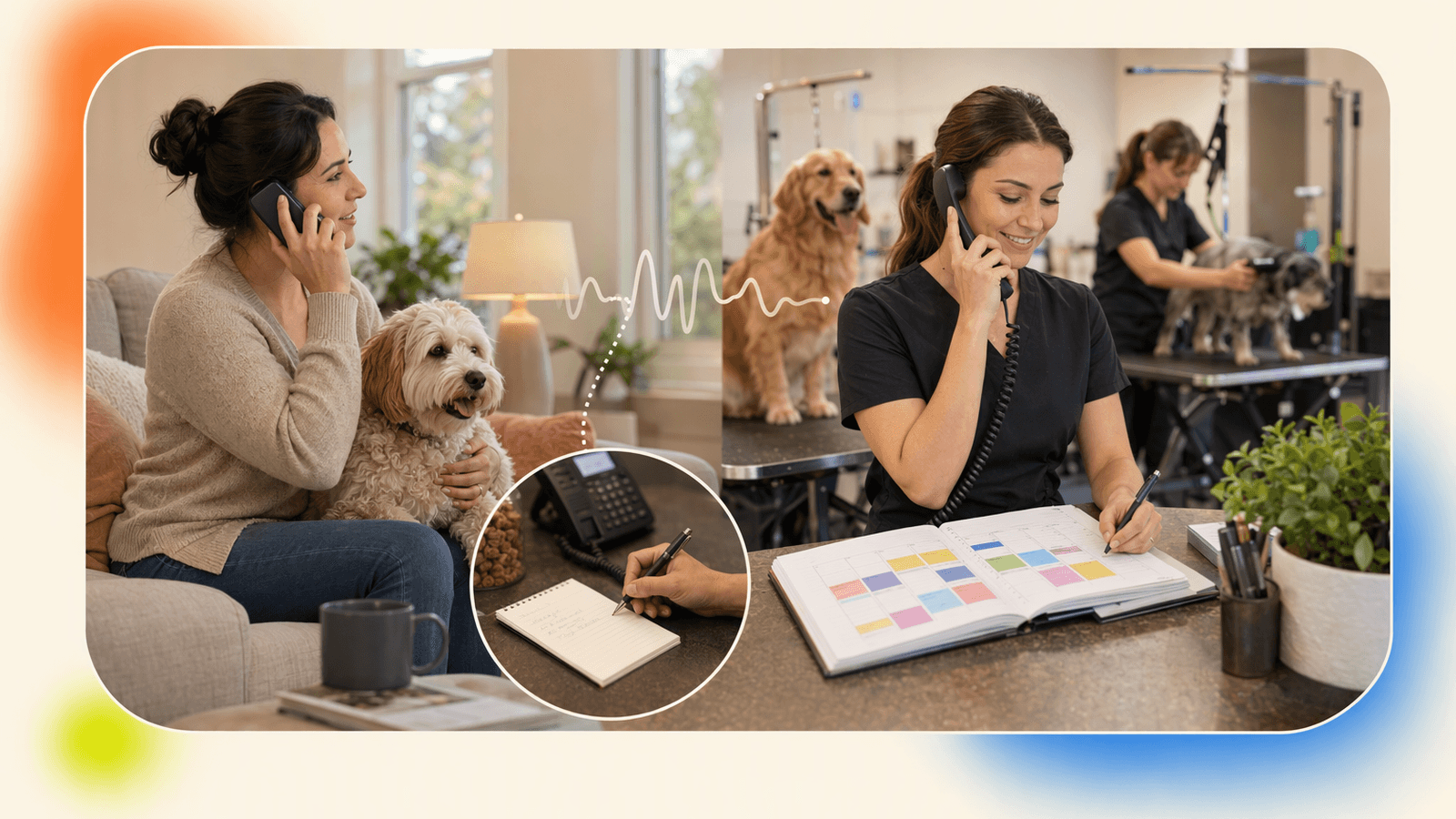
The cheapest answering service rates and pricing are not always the cheapest operating model. A message that says “Sarah called about highlights” still creates work. A booked appointment removes work.
| Capability | Basic answering | Appointment-focused AI receptionist |
|---|---|---|
| Pick up calls | Yes | Yes |
| Take messages | Yes | Yes |
| Answer common service questions | Sometimes, depending on script | Yes, based on your business setup |
| Book appointments | Often higher tier or manual process | Core use case |
| Reschedule or cancel | Often limited | Supported as part of appointment workflow |
| Calendar sync | Not always included | Google Calendar, Mindbody, Square |
| After-hours coverage | Usually available, may affect cost | 7×24 coverage |
| Escalate complex calls | Usually transfer or message | Escalates complex situations to you |
A live answering service can be a strong fit when you need human judgment, legal intake, medical triage, or complex account handling. DeskBuddy is designed for service businesses where the repeatable job is: answer my phone, answer common questions, and help customers book.
How DeskBuddy handles predictable monthly call coverage
DeskBuddy is a monthly AI phone receptionist for small appointment-based businesses. It answers calls 7×24, speaks naturally with callers, handles common inquiries, and helps with booking workflows. Setup is designed to take about 5 minutes, with no technical work required.
Key details:
- Standard: $39.9/month with 100 included calls
- Professional: $99.9/month with 300 included calls and support for up to 5 locations
- Overage: $1.00/call on Standard, $0.50/call on Professional
- Integrations: Google Calendar, Mindbody, and Square
- Languages: English, Spanish, and Chinese
- Trial: 7 days, 20 calls, no credit card required
The point is not to make every call “free.” The point is to avoid surprise labor-like costs while giving callers a useful next step.
For more detail, see DeskBuddy pricing, Google Calendar booking support, Mindbody appointment workflows, and Square-connected appointment operations.
Migration guide for businesses outgrowing per-call answering
If your live answering bill keeps rising, move in steps.
1. Pull three months of call data
Export or request total answered calls, missed calls, after-hours calls, average call length, transfers to staff, appointment-related calls, spam or wrong-number calls, and monthly invoice totals.
2. Tag call outcomes
For one week, mark calls as new appointment, reschedule, cancellation, price/service question, existing customer question, vendor/spam/wrong number, or needs owner callback.
3. Compare cost per useful outcome
Do not stop at cost per call. Calculate cost per booked appointment, cost per saved staff interruption, cost per after-hours booking, and cost per owner callback avoided.
4. Start with low-risk call forwarding
Most businesses can begin by forwarding missed calls, after-hours calls, or overflow calls. That lets you test caller experience before changing your main number workflow.
5. Keep escalation rules simple
Define when DeskBuddy should pass the situation to you: angry customer, refund request, medical or safety concern, special pricing exception, VIP client request, or anything outside your approved services.
Worksheet: estimate your true monthly call answering cost
Use this worksheet before comparing any telephone answering service pricing.
| Line item | Formula | Your number |
|---|---|---|
| Monthly calls needing coverage | Missed + overflow + after-hours calls | ___ |
| Vendor base fee | Monthly platform or package fee | $___ |
| Per-call rate | Quoted rate per handled call | $___ |
| Per-minute rate, if used | Quoted rate × average minutes × calls | $___ |
| Booking add-on fee | Calendar or appointment tier cost | $___ |
| Transfer or patch fees | Per transfer × transfer count | $___ |
| Overage fees | Calls above included allowance × overage rate | $___ |
| Staff callback time | Hours spent calling back × staff hourly cost | $___ |
| Estimated lost bookings | Missed appointment calls × average ticket | $___ |
| Total true monthly cost | Add all relevant lines | $___ |
Example:
- 120 calls per month need help
- Live answering quote: $2.50 per call plus $49 base fee
- Booking support: $49 add-on
- Staff still spends 4 hours/month calling customers back
Call charges alone are $300. Add the base fee and booking add-on, and the invoice reaches $398 before staff time. In that case, a DeskBuddy Professional plan at $99.9/month may be worth testing because it includes 300 calls and is built around appointment workflows.
If you only receive 12 simple calls a month and just need message capture, per-call pricing may still be the better fit.
How to Build an App Like This with Tencent RTC
To build a DeskBuddy-style receptionist, use Tencent RTC for low-latency voice sessions, then connect your speech-to-text, intent logic, booking system, and escalation workflow. A typical implementation creates a short-lived UserSig on your backend, joins the caller and AI agent to a secure room, streams audio to your conversation service, and writes confirmed appointments back to Google Calendar, Mindbody, Square, or your own scheduler. Start with Tencent’s official guidance for UserSig generation at https://trtc.io/document/35166 and Web SDK integration at https://trtc.io/document/48353.
// Backend: issue a short-lived RTC credential after authenticating the business.
app.post("/rtc/token", async (req, res) => {
  const { userId, roomId } = req.body;
  const userSig = createTencentUserSig({ userId, ttl: 3600 });
  res.json({ sdkAppId: process.env.TRTC_SDK_APP_ID, userId, roomId, userSig });
});
// Call event: route routine booking requests to automation, escalate exceptions.
async function handleIntent(call) {
  if (call.intent === "book_appointment") return createBooking(call);
  if (call.intent === "reschedule") return updateBooking(call);
  return notifyOwner({ reason: "human_follow_up", transcript: call.transcript });
}
The production version should also log consent, store transcripts securely, retry booking API failures, and define clear handoff rules for refunds, emergencies, or unusual customer requests.
Never miss another customer call.
Get started freeKeep reading
Live Virtual Receptionist vs AI Receptionist Guide
Compare live virtual receptionist services with AI receptionists for booking calls, pricing, coverage, and customer fit. See what to choose.

AI Phone Answering Service vs Live Answering: 2026 Guide
Compare ai phone answering service options with live answering for booking calls, pricing, handoff, and 24/7 coverage. Try DeskBuddy today.

Answering Service Pricing Comparison: 2026 Cost Guide
Compare answering service pricing models, hidden fees, and AI receptionist costs. Use practical examples to choose the best fit.